

| RAGTIME LINER NOTES |
Ragtime music is now just over one hundred years old and that alone qualifies
it as classic. It is well-loved for its syncopated rhythms and catchy tunes that
people find appealingly irresistible. Ragtime was born in the saloons and
brothels of 1890s America, brought to life principally by African-American
composer-pianists engaged to play in those venues. Needless to say, because
of its commercial and ethnic parentage ragtime was decried by religious
moralists of time as degenerate music that posed dire consequences for
listeners. But, the infectiously happy nature of this purely American music
easily won the hearts and ears of the entire nation and fears of devilish
influences were quickly quashed. Jazz music eventually displaced ragtime by
the 1920s and ragtime lay dormant for nearly fifty years until Hollywood
revived it with the Oscar-winning movie, The Sting in 1973. Thirty years later,
ragtime's resurgence has now pervaded all aspects of today's society. The
ubiquitous popularity of Scott Joplin's The Entertainer is such that it has
become a ringer option on mobile phones world-wide! Ragtime is here to stay
forever. We now proudly recognize it as America's home-grown classical
music.
The Cannon Ball, modestly subtitled "A Characteristic Two-Step" and
published in 1905, was one of the most popular rags ever written. It was
composed by Joseph C. Northup and arranged by Thomas R. Confare. Not
much is known about these two musicians, but their collaboration on this
particular work is remarkable for its combination of classical and rag piano
techniques. Cascades of classical arpeggios and handfuls of repeated chords
reminicent of Franz Liszt are mixed together with typical ragtime syncopation
to produce an "explosive" virtuoso work that is as much fun to play as it is to
hear.
Artie Matthews grew up studying piano in Springfield, Illinois in the 1890s and
moved to St. Louis in 1908 to become a composer and arranger at the Booker
T. Washington Theater and for Scott Joplin's well-known publisher, John
Stark. Matthews has the distinction of being the first person ever to publish a
blues, his Baby Seals Blues of 1912. His Weary Blues of 1915 was so popular
that it was recorded by a number of famous musicians including Louis
Armstrong, Jelly Roll Morton, the Dorsey Brothers Orchestra, and Lawrence
Welk. The five Pastime Rags (all subtitled "A Slow Drag") that he wrote
during his time in St. Louis are among the most inventive and brilliantly
conceived "classic" rags ever composed. They are full of non-stop harmonic
and rhythmic surprises as if Matthews were trying to document every ragtime
trick in the book. Of particular note are the stop time passages (possibly an
influence from the elder Joplin?) where the music suddenly comes to a halt
and the pianist is supposed to fill in the beats with hand clapping or foot
stomping. Also interesting are the comical tone clusters of the opening melody
of Pastime Rag No. 4 and a short passage in Pastime Rag No. 3 that
vividly evokes scenes of the proverbial damsel-in-distress tied to a railroad
track taken straight from silent movie music. Despite all the slap-stick comedic
devices, Matthews was evidently very serious about his compositions being
played well. Beside the tempo markings is the direction, "Don't Fake!"
Scott Joplin, James Scott, and Joseph Lamb have often been referred to as the
"Bach, Beethoven, and Brahms" of the ragtime world since they were the three
towering figures among scores of ragtime composers. Actually, they are closer
in comparison to Beethoven, Liszt, and Chopin respectively. Scott Joplin is the
acknowledged master of the genre who codified ragtime's compositional form
and garnered artistic integrity and respect for it. His publishers frequently
billed him on his sheet music covers as "The King of Ragtime Writers" not
undeservedly. Joplin's Maple Leaf Rag was composed in 1899 and was his
first big hit. (It also became the first piece of sheet music in history to sell over
a million copies.) It made Joplin famous and the requisite financial success
allowed him to become a full-time composer/teacher and move to New York to
escape the undignified and anonymous honky-tonk and red-light circuits of
St. Louis and Kansas City. Joplin is credited for creating a remarkable fusion
of African-American rhythms, American folk song (both black and white), and
European musical traditions. His seriousness as a composer is relected in the
many inspired and diverse works he created: rag two-steps, marches,
cakewalks, waltzes, dances, pianistic exercises, and even an opera. Besides
Maple Leaf, also included here are Bethena--A Concert Waltz (1905)
and Solace--A Mexican Serenade (a tango from 1909), two contrasting
works that show Joplin's mastery of style, form, melody and harmonic
adventurousness.
James Scott is represented here by two of his most popular rags, Hilarity
Rag (1910) and Ragtime Oriole (1911). Like Joplin, Scott was another
product of Missouri, the state that proved to be fertile ground for many
ragtime composers. Scott was a virtuoso pianist and his compositions reflect
that ability. Hilarity Rag is obviously modeled on Joplin's Maple Leaf
Rag but extends the already bravura technical demands of that work to
Lisztian proportions. Scott frequently writes long passages of octaves and
awkwardly-spaced chords that work musically but require large hands for ease
of execution.
Joseph F. Lamb was one of only a handful of white ragtime composers. In
1907 at the age of 20 he met and became a protege of Scott Joplin in New York.
(Joplin was nearly twenty years older.) Joplin immediately recognized Lamb's
talent and helped him arrange and publish his music. Lamb's style is less
physically extroverted and emphasizes the lyrical potential of ragtime. His
majestic harmonies and delicate Chopinesque melodies evoke a more
melancholy classicism than is normally found in ragtime. His seriousness
would certainly have appealed to Joplin's compositional purity. Of all ragtime
repertoire, Lamb's music best lends itself to interpretive possibilities and
requires tasteful use of the rubato typically found in Romantic classical music.
Not surprisingly, "Slow March Tempo" is Lamb's frequent tempo indication.
American Beauty (1913) and Ragtime Nightingale (1915) are probably
his two finest works. Lamb modeled the opening left-hand passage of
Nightingale directly from the accompaniment in Chopin's Revolutionary
Etude.
Like Joseph Northup, Jay Roberts and Robert Hampton are relatively obscure
composers who are remembered for one or two remarkable stunt rags.
Roberts' The Entertainer's Rag (1910) was another million-selling favorite
like Joplin's Maple Leaf, and shows many compositional influences of
Joplin. What makes this piece unique and memorable however is the
ingenious marriage of North and South tucked away in a middle section.
Roberts simultaneously combines the tunes of Yankee Doodle and Dixie in left
and right hands respectively as an unexpected musical surprise. This
entertainer was obviously calculated to appeal without prejudice to both
Northern and Southern tastes. Robert Hampton was another of the many
notable St. Louis ragtimers whose music was published by Joplin's publisher
John Stark. Hampton's Cataract Rag (1914) is similar to Northup's
Cannon Ball in its successful combination of ragtime musical language and
classical piano technique. There are tension-building passages of chromatic
octaves borrowed from Liszt and stormy arpeggios reminiscent of Beethoven
interspersed with familiar ragtime idioms.
One contemporary rag has been included in this collection. Written in 1970 in
memory of his father, William Bolcom's Graceful Ghost Rag is one of the
most beautiful rags ever composed. Born in Seattle in 1938, Mr. Bolcom has
been a vigorous leader of the ragtime revival in America and has composed
nearly two dozen piano rags since the late 1960s. Graceful Ghost is an
extraordinarily expressive work with touches of sophisticated jazz harmony
composed within the traditional ragtime structural format.
George Gershwin was born in New York just as ragtime was in its nascence,
thus by the time Gershwin was a teenager, ragtime's popularity was already
beginning to wane. In the summer of 1916 at age 17 while employed as a staff
accompanist at Jerome H. Remick & Co. music publishers in New York,
Gershwin composed Rialto Ripples Rag in collaboration with fellow
Remick staff member Will Donaldson. It was Gershwin's first published solo
instrumental work and effectively bridges traditional ragtime and the
newly-emerging novelty style that became popular in the 1920s and was the
specialty of Gershwin's friend, composer-pianist Zez Confrey. Novelty piano
works updated the basic ragtime format with jazzier harmonies, player piano
roll breaks (idiomatic cascades of intricate passagework), and with tunes
written in endless chains of triplets and/or dotted rhythms and based on
harmonic intervals of thirds and especially, fourths (which provided a trendy,
"Asian" flavor). Gershwin's Merry Andrew is a typical example. This piece
was originally listed as "Melody No. 43," Comedy Dance in the Gershwin Tune
Book and was used as an instrumental number called Setting-Up Exercises in
the 1928 Broadway musical, Rosalie.
Edward Elzear "Zez" Confrey, a native of Illinois, is best known for his novelty
rag, Kitten on the Keys, his smash instrumental hit of 1921. Generations of
pianists have played or attempted to play this lively and entertaining work and
it has remained in print ever since its composition. Kitten rivals Maple Leaf
for most-popular rag status. According to the composer it was inspired by
strange sounds emanating from his grandmother's old upright piano after
bedtime one evening. When Confrey went downstairs to investigate he
discovered her cat walking back and forth across the keyboard! Confrey and
Gershwin had remarkably similar early pianistic careers (they were born only
three years apart). As young men, both were engaged to make player piano
rolls and early disc recordings, both composed popular songs, and both
participated as soloists in jazz bandleader Paul Whiteman's historic February
12, 1924 Aeolian Hall concert in New York, called "An Experiment in Modern
Music." Confrey played his Kitten on the Keys and other solos on the first
half. Gershwin premiered his Rhapsody in Blue on the second half. Confrey
later went on to form his own jazz bands and dance orchestras, making a living
both as a performer and composer. Confrey studied classical piano at Chicago
Musical College where his thorough pianistic training introduced him to the
modern jazz harmonies of the French impressionists Debussy and Ravel and
the technical keyboard wizardry of Liszt. Both of these influences are easily
heard in Coaxing the Piano and Dizzy Fingers, two of Confrey's
best-known virtuoso showpieces.
America's last great ragtime composer-pianist, James Hubert "Eubie" Blake,
was born in Baltimore in 1883 and lived to age 100. Blake experienced
ragtime's birth and rebirth and was not just a rag pianist and composer, but
also a vaudeville performer, a Broadway show composer, a bandleader, and
later in life, an author, lecturer, humanitarian, mentor to young pianists, and
receipient of the Presidential Medal of Freedom (1970). Like many ragtime
pianists, Blake earned money as a teenager playing in Baltimore brothels,
much to his parents consternation. His famous showpiece was The Charleston
Rag composed in 1899, the same year as Joplin's Maple Leaf. Many of
Blake's rags are named for colorful characters from his youth. The first strain
of his ragtime blues, Poor Katie Redd, subtitled "Eubies Slow Drag," comes
from an old, turn-of-the-century pop tune heard around St. Louis called
"Katie Redd, Katie Redd, who's been sleeping in my bed?" Blake wrote
Brittwood Rag around 1907 and soon afterward, completely forgot about it.
Many years later he heard a pianist play a rag that he liked very much in a
Harlem cabaret called The Brittwood. When he inquired about the name and
composer of the rag, the pianist told him it was by Eubie Blake. Much to his
surprise, he had rediscovered his own composition! In 1962 he finally began
writing down many of the rags he had composed over a half-century before.
Like many of Blake's rags, The Baltimore Todolo and Brittwood Rag are
difficult to play because of high-speed syncopated polyrhythms,
boogie-woogie left-hand figurations, long passages of right-hand melodies in
octaves, and filled-out left-hand tenth chords. (His gigantic hands could reach
twelve notes!) Blake created his own unique style of ragtime; he does not
adhere to Joplin's established form, and his harmonic and rhythmic style
naturally reflects the influence of the jazz music he grew up hearing. As a
result, his rag music is frequently tinged with blues and a touch of swing.
This recording is respectfully dedicated to the memory of my father, Donald J.
Dowling, who introduced me to the joy of ragtime as a boy and with whom I
shared many wonderful occasions making music together at home.
it as classic. It is well-loved for its syncopated rhythms and catchy tunes that
people find appealingly irresistible. Ragtime was born in the saloons and
brothels of 1890s America, brought to life principally by African-American
composer-pianists engaged to play in those venues. Needless to say, because
of its commercial and ethnic parentage ragtime was decried by religious
moralists of time as degenerate music that posed dire consequences for
listeners. But, the infectiously happy nature of this purely American music
easily won the hearts and ears of the entire nation and fears of devilish
influences were quickly quashed. Jazz music eventually displaced ragtime by
the 1920s and ragtime lay dormant for nearly fifty years until Hollywood
revived it with the Oscar-winning movie, The Sting in 1973. Thirty years later,
ragtime's resurgence has now pervaded all aspects of today's society. The
ubiquitous popularity of Scott Joplin's The Entertainer is such that it has
become a ringer option on mobile phones world-wide! Ragtime is here to stay
forever. We now proudly recognize it as America's home-grown classical
music.
The Cannon Ball, modestly subtitled "A Characteristic Two-Step" and
published in 1905, was one of the most popular rags ever written. It was
composed by Joseph C. Northup and arranged by Thomas R. Confare. Not
much is known about these two musicians, but their collaboration on this
particular work is remarkable for its combination of classical and rag piano
techniques. Cascades of classical arpeggios and handfuls of repeated chords
reminicent of Franz Liszt are mixed together with typical ragtime syncopation
to produce an "explosive" virtuoso work that is as much fun to play as it is to
hear.
Artie Matthews grew up studying piano in Springfield, Illinois in the 1890s and
moved to St. Louis in 1908 to become a composer and arranger at the Booker
T. Washington Theater and for Scott Joplin's well-known publisher, John
Stark. Matthews has the distinction of being the first person ever to publish a
blues, his Baby Seals Blues of 1912. His Weary Blues of 1915 was so popular
that it was recorded by a number of famous musicians including Louis
Armstrong, Jelly Roll Morton, the Dorsey Brothers Orchestra, and Lawrence
Welk. The five Pastime Rags (all subtitled "A Slow Drag") that he wrote
during his time in St. Louis are among the most inventive and brilliantly
conceived "classic" rags ever composed. They are full of non-stop harmonic
and rhythmic surprises as if Matthews were trying to document every ragtime
trick in the book. Of particular note are the stop time passages (possibly an
influence from the elder Joplin?) where the music suddenly comes to a halt
and the pianist is supposed to fill in the beats with hand clapping or foot
stomping. Also interesting are the comical tone clusters of the opening melody
of Pastime Rag No. 4 and a short passage in Pastime Rag No. 3 that
vividly evokes scenes of the proverbial damsel-in-distress tied to a railroad
track taken straight from silent movie music. Despite all the slap-stick comedic
devices, Matthews was evidently very serious about his compositions being
played well. Beside the tempo markings is the direction, "Don't Fake!"
Scott Joplin, James Scott, and Joseph Lamb have often been referred to as the
"Bach, Beethoven, and Brahms" of the ragtime world since they were the three
towering figures among scores of ragtime composers. Actually, they are closer
in comparison to Beethoven, Liszt, and Chopin respectively. Scott Joplin is the
acknowledged master of the genre who codified ragtime's compositional form
and garnered artistic integrity and respect for it. His publishers frequently
billed him on his sheet music covers as "The King of Ragtime Writers" not
undeservedly. Joplin's Maple Leaf Rag was composed in 1899 and was his
first big hit. (It also became the first piece of sheet music in history to sell over
a million copies.) It made Joplin famous and the requisite financial success
allowed him to become a full-time composer/teacher and move to New York to
escape the undignified and anonymous honky-tonk and red-light circuits of
St. Louis and Kansas City. Joplin is credited for creating a remarkable fusion
of African-American rhythms, American folk song (both black and white), and
European musical traditions. His seriousness as a composer is relected in the
many inspired and diverse works he created: rag two-steps, marches,
cakewalks, waltzes, dances, pianistic exercises, and even an opera. Besides
Maple Leaf, also included here are Bethena--A Concert Waltz (1905)
and Solace--A Mexican Serenade (a tango from 1909), two contrasting
works that show Joplin's mastery of style, form, melody and harmonic
adventurousness.
James Scott is represented here by two of his most popular rags, Hilarity
Rag (1910) and Ragtime Oriole (1911). Like Joplin, Scott was another
product of Missouri, the state that proved to be fertile ground for many
ragtime composers. Scott was a virtuoso pianist and his compositions reflect
that ability. Hilarity Rag is obviously modeled on Joplin's Maple Leaf
Rag but extends the already bravura technical demands of that work to
Lisztian proportions. Scott frequently writes long passages of octaves and
awkwardly-spaced chords that work musically but require large hands for ease
of execution.
Joseph F. Lamb was one of only a handful of white ragtime composers. In
1907 at the age of 20 he met and became a protege of Scott Joplin in New York.
(Joplin was nearly twenty years older.) Joplin immediately recognized Lamb's
talent and helped him arrange and publish his music. Lamb's style is less
physically extroverted and emphasizes the lyrical potential of ragtime. His
majestic harmonies and delicate Chopinesque melodies evoke a more
melancholy classicism than is normally found in ragtime. His seriousness
would certainly have appealed to Joplin's compositional purity. Of all ragtime
repertoire, Lamb's music best lends itself to interpretive possibilities and
requires tasteful use of the rubato typically found in Romantic classical music.
Not surprisingly, "Slow March Tempo" is Lamb's frequent tempo indication.
American Beauty (1913) and Ragtime Nightingale (1915) are probably
his two finest works. Lamb modeled the opening left-hand passage of
Nightingale directly from the accompaniment in Chopin's Revolutionary
Etude.
Like Joseph Northup, Jay Roberts and Robert Hampton are relatively obscure
composers who are remembered for one or two remarkable stunt rags.
Roberts' The Entertainer's Rag (1910) was another million-selling favorite
like Joplin's Maple Leaf, and shows many compositional influences of
Joplin. What makes this piece unique and memorable however is the
ingenious marriage of North and South tucked away in a middle section.
Roberts simultaneously combines the tunes of Yankee Doodle and Dixie in left
and right hands respectively as an unexpected musical surprise. This
entertainer was obviously calculated to appeal without prejudice to both
Northern and Southern tastes. Robert Hampton was another of the many
notable St. Louis ragtimers whose music was published by Joplin's publisher
John Stark. Hampton's Cataract Rag (1914) is similar to Northup's
Cannon Ball in its successful combination of ragtime musical language and
classical piano technique. There are tension-building passages of chromatic
octaves borrowed from Liszt and stormy arpeggios reminiscent of Beethoven
interspersed with familiar ragtime idioms.
One contemporary rag has been included in this collection. Written in 1970 in
memory of his father, William Bolcom's Graceful Ghost Rag is one of the
most beautiful rags ever composed. Born in Seattle in 1938, Mr. Bolcom has
been a vigorous leader of the ragtime revival in America and has composed
nearly two dozen piano rags since the late 1960s. Graceful Ghost is an
extraordinarily expressive work with touches of sophisticated jazz harmony
composed within the traditional ragtime structural format.
George Gershwin was born in New York just as ragtime was in its nascence,
thus by the time Gershwin was a teenager, ragtime's popularity was already
beginning to wane. In the summer of 1916 at age 17 while employed as a staff
accompanist at Jerome H. Remick & Co. music publishers in New York,
Gershwin composed Rialto Ripples Rag in collaboration with fellow
Remick staff member Will Donaldson. It was Gershwin's first published solo
instrumental work and effectively bridges traditional ragtime and the
newly-emerging novelty style that became popular in the 1920s and was the
specialty of Gershwin's friend, composer-pianist Zez Confrey. Novelty piano
works updated the basic ragtime format with jazzier harmonies, player piano
roll breaks (idiomatic cascades of intricate passagework), and with tunes
written in endless chains of triplets and/or dotted rhythms and based on
harmonic intervals of thirds and especially, fourths (which provided a trendy,
"Asian" flavor). Gershwin's Merry Andrew is a typical example. This piece
was originally listed as "Melody No. 43," Comedy Dance in the Gershwin Tune
Book and was used as an instrumental number called Setting-Up Exercises in
the 1928 Broadway musical, Rosalie.
Edward Elzear "Zez" Confrey, a native of Illinois, is best known for his novelty
rag, Kitten on the Keys, his smash instrumental hit of 1921. Generations of
pianists have played or attempted to play this lively and entertaining work and
it has remained in print ever since its composition. Kitten rivals Maple Leaf
for most-popular rag status. According to the composer it was inspired by
strange sounds emanating from his grandmother's old upright piano after
bedtime one evening. When Confrey went downstairs to investigate he
discovered her cat walking back and forth across the keyboard! Confrey and
Gershwin had remarkably similar early pianistic careers (they were born only
three years apart). As young men, both were engaged to make player piano
rolls and early disc recordings, both composed popular songs, and both
participated as soloists in jazz bandleader Paul Whiteman's historic February
12, 1924 Aeolian Hall concert in New York, called "An Experiment in Modern
Music." Confrey played his Kitten on the Keys and other solos on the first
half. Gershwin premiered his Rhapsody in Blue on the second half. Confrey
later went on to form his own jazz bands and dance orchestras, making a living
both as a performer and composer. Confrey studied classical piano at Chicago
Musical College where his thorough pianistic training introduced him to the
modern jazz harmonies of the French impressionists Debussy and Ravel and
the technical keyboard wizardry of Liszt. Both of these influences are easily
heard in Coaxing the Piano and Dizzy Fingers, two of Confrey's
best-known virtuoso showpieces.
America's last great ragtime composer-pianist, James Hubert "Eubie" Blake,
was born in Baltimore in 1883 and lived to age 100. Blake experienced
ragtime's birth and rebirth and was not just a rag pianist and composer, but
also a vaudeville performer, a Broadway show composer, a bandleader, and
later in life, an author, lecturer, humanitarian, mentor to young pianists, and
receipient of the Presidential Medal of Freedom (1970). Like many ragtime
pianists, Blake earned money as a teenager playing in Baltimore brothels,
much to his parents consternation. His famous showpiece was The Charleston
Rag composed in 1899, the same year as Joplin's Maple Leaf. Many of
Blake's rags are named for colorful characters from his youth. The first strain
of his ragtime blues, Poor Katie Redd, subtitled "Eubies Slow Drag," comes
from an old, turn-of-the-century pop tune heard around St. Louis called
"Katie Redd, Katie Redd, who's been sleeping in my bed?" Blake wrote
Brittwood Rag around 1907 and soon afterward, completely forgot about it.
Many years later he heard a pianist play a rag that he liked very much in a
Harlem cabaret called The Brittwood. When he inquired about the name and
composer of the rag, the pianist told him it was by Eubie Blake. Much to his
surprise, he had rediscovered his own composition! In 1962 he finally began
writing down many of the rags he had composed over a half-century before.
Like many of Blake's rags, The Baltimore Todolo and Brittwood Rag are
difficult to play because of high-speed syncopated polyrhythms,
boogie-woogie left-hand figurations, long passages of right-hand melodies in
octaves, and filled-out left-hand tenth chords. (His gigantic hands could reach
twelve notes!) Blake created his own unique style of ragtime; he does not
adhere to Joplin's established form, and his harmonic and rhythmic style
naturally reflects the influence of the jazz music he grew up hearing. As a
result, his rag music is frequently tinged with blues and a touch of swing.
This recording is respectfully dedicated to the memory of my father, Donald J.
Dowling, who introduced me to the joy of ragtime as a boy and with whom I
shared many wonderful occasions making music together at home.
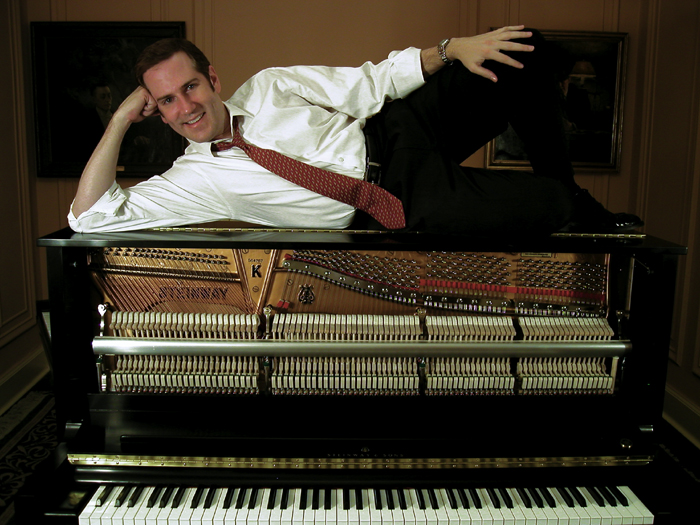
| WORLD'S GREATEST PIANO RAGS: RICHARD DOWLING PLAYS RAGTIME Klavier CD 77035 |
 |
| |
 |
| |
 |
| |
 |
| |
 |
| |
 |
| |
 |
| |
 |
| |
 |
| |
 |
